Monday, September 27, 2010

Talking Taxes

I think it might be helpful if we took a step back and discussed our income tax system in general, and then look at what effects the Bush tax-cuts of 2001 and 2003 had on that system.

The first thing to understand about the income tax is that it is a progressive tax. That means that the more income you earn the more you pay in taxes. There are a lot of rationales for adopting a progressive tax-rate structure but the most common is called the ability-to-pay argument. Low and middle income tax-payers devote a higher proportion of their income to paying for the necessities of live, such as food, shelter and medical care. They are more likely to be living from paycheck to paycheck then are high-income earners. High-earners can easily afford to cover the necessities of life and still have a large amount left over to spend on luxury items and the like. Therefore, high-earners can afford to pay a higher tax-bill without feeling the same level of economic hardship as low and middle income earners.

President Bush and Congressional Republicans pushed through changes in how dividends, capital gains, and wealthy estates are taxed, but let’s just focus on the changes in the income tax. President Bush changed the income tax-brackets in 2001 and 2003 like so:


President Obama has proposed letting the top two tax-rates on income earned over $200,000 by an individual ($250,000 for a family) reset to the levels under the Clinton Administration. That would mean a change from the current rates of 33 and 35 percent to 36 and 39.6 percent, respectively. So does that mean a family earning $250,001 will have to fork over $90,000 (36 percent of $250,000)? Nope. Annie Lowrey explains why in a post for The Washington Independent:

Pop quiz. Say you make a steady $250,001, every year. How many dollars of additional income tax will you pay if the Obama administration’s tax plan goes through? A thousand dollars? A few thousand? Nope. Three cents.


Here’s how it works. Your taxes below $250,000 remain the same. And on that excess $1, your income tax rate increases from 33 percent to 36 percent. For most earners making between $250,000 and $500,000 a year, the Obama plan would increase income tax liability by just a few hundred dollars — an average of $600, according to the Center for Economic and Policy Research’s Dean Baker.


Slightly left of center think-tank The Center on Budget and Policy Priorities explains further, with one of the neatest metaphors I’ve ever read in policy paper:

This crucial distinction is often overlooked. It is perhaps best explained through a metaphor: the income tax operates as a staircase, not an elevator. This means that people who make $1 million a year do not go directly to the top “floor” (i.e., to the top tax rate, currently 35 percent) but instead take the “stairs,” paying tax on the first increment of taxable income at 10 percent, paying tax on the next increment at 15 percent, and so on until reaching the top rate.


Because of this, the 10 percent bracket — which the 2001 tax law carved out from within the old 15 percent bracket — reduces taxes not only for people whose incomes fall within that bracket, but for every taxpayer whose income exceeds the 10 percent bracket, as well. In fact, taxpayers in higher brackets receive the maximum possible benefit from the 10 percent bracket.


Members of a certain political party often talk as though the totality of a high-earners income will be taxed at the same top rate, when in fact it will be taxed at all the different, lesser, rates on the way up to the top. Whether they do this because they are ignorant or lying is an open question I won’t address here (But I have theories!). Regardless of their motives, because they do this you can count on some opponents in round making the same mistake. If you call them on it, it will totally undermine their credibility on the issue. So do that.

I’m a real wind-bag when I get going about taxes. I’ll stop now and just add some more articles that are worth reading:

Analysis Looks at Effect of Letting Tax Cuts Lapse for Rich - NYTimes.com
A concise summary of Obama's tax-proposal.

"Extending them for the next 10 years would add about $3.8 trillion to a growing national debt that is already the largest since World War II. About $700 billion of that reflects the projected costs of tax cuts for those in the top 2 percent of income-earners."


Tax Cuts May Be Good Politics but Poor Stimulus - NYTimes.com

"The nonpartisan Congressional Budget Office this year analyzed the short-term effects of 11 policy options and found that extending the tax cuts would be the least effective way to spur the economy and reduce unemployment. The report added that tax cuts for high earners would have the smallest “bang for the buck,” because wealthy Americans were more likely to save their money than spend it."


A Gift for the Nation - Ending Tax Cuts for the Wealthy - NYTimes.com

"Because most poor and middle-income families consume their entire income, higher tax rates for those families would indeed deprive the economy of much-needed short-run stimulus. But extending the Bush tax cuts for the wealthiest families would be one of the worst possible ways to stimulate spending. These families typically consume much less than their income. Instead of trying to use up all their savings before they die, most prefer to leave substantial bequests. Letting their tax cuts expire might reduce those bequests, but it will not reduce their current consumption significantly.


It will, however, generate revenue that could be used to bolster spending in a host of ways that would be useful even apart from the stimulus effects. Because state and local government budgets are in shambles, hundreds of teachers, police officers and firefighters are being laid off every week. Federal grants could keep them on the job."


Why the Rich Don’t Need a Tax-Cut Extension - NYTimes.com

"The second argument is that not extending the tax cuts to high-income earners would impose an excessive burden on small businesses. Here, however, we fall into a statistical morass. The administration points out that only 3 percent of all businesses earn enough to have to pay any additional tax. But Republicans reply that those 3 percent of businesses earn 47 percent of the income from this entire sector, meaning that the higher taxes would apply to the bulk of small-business income.

Which is the most relevant number?


To understand these statistics, we need to know how small business is defined. The data come from tax returns, and the definition of a “small” business is one that is organized so that all the profits pass through to the owners, who then report these profits as income on their personal tax returns.


Partnerships and firms structured as S corporations are examples. This category can include businesses as diverse as barbershops, car washes, hedge funds and law firms. Goldman Sachs was in this category before it became a public company. And the fact that 3 percent of the businesses earn nearly half of the money is precisely what many people are concerned about: growing income inequality."


Why Congress Should Let the Bush Tax Cuts Expire - Daniel Gross, Newsweek

One Nation, Two Deficits - Peter Orzag, NYTimes.com
Peter Orzag, Obama's former director of the Office of Management and Budget (OMB), advocates temporarily extending all of the Bush tax-cuts for two years and letting all of them expire (middle-class cuts included). He's concerned about our future deficit.

"In the face of the dueling deficits, the best approach is a compromise: extend the tax cuts for two years and then end them altogether. Ideally only the middle-class tax cuts would be continued for now. Getting a deal in Congress, though, may require keeping the high-income tax cuts, too. And that would still be worth it.”

Wednesday, March 24, 2010

Health Care Reform reading list

Health care reform has gone from being a long and tedious argument to a reality, so I thought I would share some articles that bring the policy details. Hopefully it will have died down as an issue by the time all of you compete, but I imagine you'll get a resolution along the lines of, "This house believes Health-Care Reform will sink the Democrats."

So onward to knowledge! (If I was a superhero that would be my catch-phrase. I would be the lamest superhero ever.)

The Awful Status-quo

Before we get into the solutions, let's look at the harms:

The Uninsured and the Difference Health Insurance Makes - Kaiser Family Foundation (PDF)
This fact sheet describes the characteristics of the uninsured population, the difference health insurance makes, and why there is a large uninsured population.

Blue Cross praised employees who dropped sick policyholders, lawmaker says - Los Angeles Times
This article does a pretty good job of illustrating the insurance company practice known as rescission. Rescission is when an insurance company combs through the medical histories of their expensive (re: extremely ill) customers in order to retroactively drop their coverage.

“Pre-Existing Conditions” Affect Millions of Americans - Healthreform.gov (PDF)
A pre-existing condition is a medical condition that existed before someone applies for or enrolls in a new health insurance policy. Insurance companies frequently deny people coverage on the basis of pre-existing conditions.

General Reform Guides

At its core, health care reform is very simple to grasp. I'll let Paul Krugman explain:

Start with the proposition that we don’t want our fellow citizens denied coverage because of preexisting conditions — which is a very popular position, so much so that even conservatives generally share it, or at least pretend to.

So why not just impose community rating — no discrimination based on medical history?

Well, the answer, backed up by lots of real-world experience, is that this leads to an adverse-selection death spiral: healthy people choose to go uninsured until they get sick, leading to a poor risk pool, leading to high premiums, leading even more healthy people dropping out.

So you have to back community rating up with an individual mandate: people must be required to purchase insurance even if they don’t currently think they need it.

But what if they can’t afford insurance? Well, you have to have subsidies that cover part of premiums for lower-income Americans.

In short, you end up with the health care bill that’s about to get enacted. There’s hardly anything arbitrary about the structure: once the decision was made to rely on private insurers rather than a single-payer system — and look, single-payer wasn’t going to happen — it had to be more or less what we’re getting.

So the pieces of reform are interdependent. You can't ban discrimination by insurers on the basis of pre-existing conditions without an individual mandate. Otherwise you run the risk of driving up premiums for everyone and allowing people to free-ride on the new system. Having an individual mandate means creating a system of financial assistance for low and middle income citizens. Hence the subsidies. It is all of a piece.

Here are some articles and policy papers giving the big picture on health reform.

For Consumers, Clarity on Health Care Changes - New York Times
Nice little brief on how the law will affect most Americans.

Summary of Coverage Provisions in the White House/Congressional Leadership Reconciliation Act of 2010, Health Care and Education Reconciliation Act - Kaiser Family Foundation (PDF)
More details.

Health Reform Package Represents Historic Chance to Expand Coverage, Improve Insurance Markets, Slow Cost Growth, and Reduce Deficits - Center on Budget and Policy Priorities
Even more details.

Chart: How the bill affects you - Los Angeles Times
Visual aid!

Specifics


How big is the bill, really? - Ezra Klein
Examines the estimated costs of the law.

Who is left uninsured by the health-care reform bill? - Ezra Klein
The number frequently bandied about for the number of uninsured in the US is around 45 million. The new law expands access to 32 million people. Who's left out?

Key Provisions that take effect immediately - House.gov (PDF)
As you may have noticed, most of the major components of the law are going to be phased in over time, coming into full effect by 2014. This is a rundown of the more immediate changes.

Bad bill. Bad bill.

I think the new law is pretty fantastic when compared against the status-quo. Yet as Immanuel Kant once said, "Out of the crooked timber of humanity, no straight thing was ever made." Here are some articles emphasizing the negative.

In Health Care Overhaul, Boons for Hospitals and Drug Makers - New York Times
The special interests who profit from our wasteful system are mostly left untouched.

FDL Statement on the Passage of the Health Care Bill - Jane Hamsher
Hamsher and her cohorts at Firedoglake have been the leading opponents of the health care bill on the left.

Heritage Foundation Urges Repeal of "Intolerable" Health Bill - Heritage Foundation
From the right.

That's all for now. If you have any questions or comments, share them with me and the rest of the team.

Monday, March 22, 2010

Health Care Reform

I liked this:

But there’s another argument for health care reform, one that is at once more subtle and more sweeping. The disturbing part of our health care system is the financial and physical suffering it causes. But the unjust part of our health care system is the way it distributes that suffering. There are things all of us can do to stay healthy--we can eat right, we can exercise, we can avoid excessive risks. But even when we do the right things, we remain vulnerable.

You can have the perfect diet, jog three miles every day, and wake up one morning to discover you have cancer. So now you face mortal peril. And if, on top of everything else, you can’t pay your medical bills, you face financial ruin, as well.

Chance, of course, is part of life. Americans, in particular, seem to accept that. But every now and then, we have decided that need for such expansion--that there was, even now, the kind of common vulnerability to chance that required the sorts of initiatives we had enacted in the past. It happened with the New Deal, when we created the modern welfare state, and then again with the Great Society, when we expanded it.

The signature programs of these eras, Social Security and Medicare, work because they address a vulnerability we all share. Everybody is at risk of getting old; and everybody is at risk of misfortune, physical and financial, when that happens. To protect against that misfortune--to insure against that misfortune--all of us contribute. We all give, in the form of financial contributions; and we all get, in the form of financial security. Together, quite literally, we are stronger than when we are apart.

The conservatives protesting on the Capitol lawn Saturday see things differently. Health care reform isn't about contributing money for the sake of their own security; it's about having their money taken for the sake of somebody else's security. When they hear stories of people left bankrupt or sick because of uninsurance, they are more likely to see a lack of personal responsibility and virtue than a lack of good fortune. As my colleague Jonathan Chait has observed, theirs is an extreme version of a view common (although surely not universal) on the right: That individuals can fend for themselves, as long as they are responsible and as long as the government gets out of the way.

There's obviously a balance to be struck between these two world views. But, broadly speaking, conservative ideas about responsibility and vulnerability have dominated political discussion for most of the last four decades. That will change on Sunday, if health care reform passes. The bill before Congress may be flawed. And the process that produced it may be severely flawed. But it is, nevertheless, an expression of the idea that we--as as society--are not prepared to let people continue to suffer such dire consequences just because they’re unlucky.

What the Bill does.

Monday, March 8, 2010

Economists can tell stories

Mark Thoma tells a tale about job creation and social insurance that's pretty good.

Friday, March 5, 2010

Wal-Mart Hippies

In light of more conspiracists trying to single handedly take down the USFG, here's a NYT opinion piece comparing how tea-partiers of today have far more similarities than differences to the hippies of olde.

http://www.nytimes.com/2010/03/05/opinion/05brooks.html

Friday, February 12, 2010

Campaign Contributuions and Institutional Corruption

If you have a free hour, I highly recommend you watch this excellent presentation from Harvard University's Lawrence Lessig on the dynamics of financial dependence and perceptions of institutional corruption. He makes the case that one of the most damaging aspects of our current system is that it fosters deep cynicism and distrust about the efficacy of important institutions (e.g the FDA, Congress) and thus inhibits their effectiveness. So people perceive the FDA and the medical establishment as being in the pocket of Big Pharma. So more and more people begin to discount the unassailable scientific evidence that immunizations improve health. This leads to an increase in easily treatable diseases like the measles. The perception of undue influence, whether or not you think it is actually occurring (I do), therefore detracts from the public health goals of the FDA.

It's a wide-ranging lecture that touches on a whole lot of issues, such as financial sector regulation, the economy of lobbying in Washington, and copyright law. Really worth your time.

Thursday, February 11, 2010

Did Glenn Beck rape and murder a young girl in 1990?

Did Glenn Beck rape and murder a young girl in 1990? We don't know, and Glenn Beck has yet to come forward and address the questions we need to ask. But I know you, like myself, want answers.

http://gb1990.com/

Tuesday, February 9, 2010

Libertarians can surprise me. Who knew?

Five Reasons Why Libertarians Shouldn't Hate Government - Reason Magazine:
When we tell our limited-government friends that we have written a book titled If We Can Put a Man on the Moon: Getting Big Things Done in Government, about how government can better accomplish what it sets out to do, the reaction is often horror.

“I don’t want to make government work better, I want it to go away" is the typical response. Government, in their view, is the enemy.

This way of thinking is deeply misguided, a troubling blind spot that keeps libertarians on the fringe of many policy debates. If you reflect only scorn for government, it’s hard to get anyone who hasn’t already drunk the Kool-Aid to take your opinions on the topic seriously.

This is not to disparage the argument that government is too large, for which the case is strong. But holding government in sneering contempt is a misinformed corruption of that sentiment.

Our Founding Fathers, fondly quoted by limited-government advocates, didn’t view government as evil, but as a flawed institution with some important jobs to do. They studied how government worked and they served in office, not because they viewed government with disdain, but because they knew the importance of good government...

The whole thing is worth checking out.

Sunday, January 31, 2010

Talking about the Deficit - Part 1

So the federal deficit will be an issue that we will be discussing a lot this semester. So I thought I'd put together a series of posts on it, that link to some good solid info.

What is the deficit?
For any given year, the federal budget deficit is the amount of money the federal government spends (also known as outlays) minus the amount of money it takes in (also known as revenues). If the government takes in more money than it spends in a given year, the result is a surplus rather than a deficit.

When the economy is weak, people’s incomes decline, so the government collects less in tax revenues. This is one reason why the deficit often grows during recessions. Conversely, when the economy is strong and tax revenues increase, the budget deficit shrinks.

How big is the current deficit?
The deficit for fiscal 2009 was $1.4 trillion and, at an estimated 10 percent of Gross Domestic Product (GDP), was the largest deficit relative to the size of the economy since the end of World War II. Under current policies, deficits will likely exceed $1 trillion in 2010 and 2011 and remain near that figure thereafter.

What are the major causes of the rise in the deficit?

The recession:
Much of the horrific explosion in the national debt—the deficit soared from $248 billion in 2006 to $1.4 trillion in the recently concluded Fiscal Year 2009—can be pinned on cyclical factors. When the economy goes in the tank, it creates a fiscal double whammy, gutting tax receipts and boosting demand for government spending programs that are both ordinary (increasing unemployment benefits) and extraordinary (bailouts, stimulus). Spending rose 18 percent and revenues fell 16.6 percent in fiscal 2009—the worst decline seen since the 1930s, with corporate income taxes plummeting 55 percent. Had revenues been steady, the deficit would have been only (only, he said) $1 trillion

Bush Administration Policies:
Some commentators blame recent legislation — the stimulus bill and the financial rescues — for today’s record deficits. But those costs pale next to other policies enacted since 2001 that have swollen the deficit. They are less conspicuous now, because many were enacted years ago, and they have long since been absorbed into CBO’s and other organizations’ budget projections.

Just two policies dating from the Bush Administration — tax cuts and the wars in Iraq and Afghanistan — accounted for over $500 billion of the deficit in 2009 and $7.1 trillion in 2009 through 2019, including the associated debt-service costs. These impacts easily dwarf the stimulus and financial rescues. Furthermore, unlike those temporary costs, these inherited policies (especially the tax cuts) do not fade away as the economy recovers (see Figure 1).

Without the economic downturn and the fiscal policies of the previous Administration, the budget would be roughly in balance over the next decade. That would put the nation on a much sounder footing to address the demographic challenges and the cost pressures in health care that darken the long-run fiscal outlook.
Obama Administration Policies:
Mr. Obama’s main contribution to the deficit is his extension of several Bush policies, like the Iraq war and tax cuts for households making less than $250,000. Such policies — together with the Wall Street bailout, which was signed by Mr. Bush and supported by Mr. Obama — account for 20 percent of the swing.

About 7 percent comes from the stimulus bill that Mr. Obama signed in February. And only 3 percent comes from Mr. Obama’s agenda on health care, education, energy and other areas.

If the analysis is extended further into the future, well beyond 2012, the Obama agenda accounts for only a slightly higher share of the projected deficits.
All together now:


— “The first category — the business cycle — accounts for 37 percent of the $2 trillion swing.”

— Second, Bush-era legislation “like his tax cuts and the Medicare prescription drug benefit, [that] not only continue to cost the government but have also increased interest payments on the national debt.”

— Third, “Obama’s main contribution to the deficit is his extension of several Bush policies, like the Iraq war and tax cuts for households making less than $250,000 [...] 20 percent of the swing.”

— Fourth, “About 7 percent comes from the stimulus bill that Mr. Obama signed in February.”

— Fifth, “only 3 percent comes from Mr. Obama’s agenda on health care, education, energy and other areas.”

So these are just the facts about our current deficit. My next post will focus on what having such a large deficit means, why its good to deficit spend sometimes, why its bad other times, and whether right now is the former or the latter.

Linked articles/Further reading:

Friday, January 29, 2010

Obama endorses Milholland/Wells Space Privatization Strategy

Had no idea this was in the works:
President Obama will end NASA’s return mission to the moon and turn to private companies to launch astronauts into space when he unveils his budget request to Congress next week, an administration official said Thursday.
...
Mr. Obama’s request, which will be announced on Monday, would add $6 billion over five years to the National Aeronautics and Space Administration’s budget compared with projections last year. With the increase, NASA would receive $100 billion over the 2011 through 2015 fiscal years.

The new money would largely go to commercial companies that would provide transportation to and from the International Space Station. Until now, NASA has designed and operated its own spacecraft, like the space shuttles.

The commercial rockets would displace the Ares I, the rocket that NASA has been developing for the past four years to replace the shuttles, which are scheduled to be retired this year. Companies expected to seek the new space taxi business include United Launch Alliance, a partnership between Boeing and Lockheed Martin that launches rockets for the United States Air Force, and Space Exploration Technologies, a start-up company led by Elon Musk, who founded PayPal.
Couple of thoughts on this. One, I think that the history of government privatization schemes has shown that it usually doesn't accrue to the public interest. To get the private sector to do something it isn't already doing or wants to do, the government usually has to sweeten the pot a whole lot to get them on board. Well see how this shakes out.

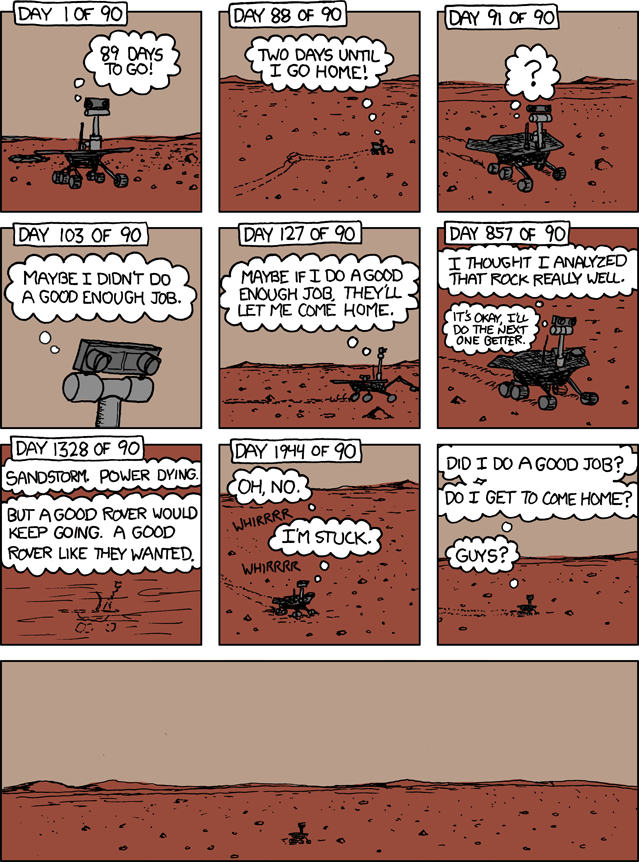
Two: The stubborn insistence on maintaining human space exploration seems like bad policy to me. For one thing it is much more expensive to send humans into space than robots. Robots don't have to breathe after all. And if the Terminator franchise has taught us anything, its that robots can do all kinds of cool things humans can't. They could have eyes that take in the full-spectrum of light for instance. So not only are robots cheaper, they are better for science too. And despite what this XKCD strip would have you believe, they don't have feelings.

Tuesday, January 26, 2010

Talking more about the corporate personhood debate

So there's plenty of stuff out there, but I guess to kind of open up the discussion with us- Basically under the new ruling, corporations (acting as persons) may donate unlimited amounts of money to political campaigns as well as run whatever ads they want previous to an election (McCain-Feingold banned issue ads 30 days before a campaign or some such). So basically I think we've all agreed that this is the end of civilization as we know it, but going over some of the fine points I think there's some points worth considering.

First of all, the old law was arbitrarily enforced in that some corporations had unlimited access to media. Specifically, corporations like say, the New York Times, which endorsed Barack Obama before the election. The New York Times is a corporation like any other, so why would it specifically be banned? Or to take it the other way, Fox News was also exempt. So in that respect, this law is acting as a leveler.

Also worth considering is the concept that corporations merely act as a mediator of personal communication. This is to say that corporations have rights the same way property does. A baseball does not have any rights, but by merit of my right against unreasonable seizure it acts as a vessel of my rights. This isn't the argument the court is making, because it explicitly applies 14th amendment protections to corporations. So by merit of the fact that corporations are ultimately groups of people, they acquire the right to unfettered communication.

Bear in mind that limiting groups has some bad implications. If we are going to reign in the talk of say, Pepsi, what is the meaningful distinction between Pepsi and the ACLU? One could argue it was a profit motive. Any of these limits are going to be arbitrary.

I'm still down for limiting corporate forays into public speech, they point is that McCain Feingold was a problematic means of doing it.

Cruel and unusual?

Dungeons & Dragons Prison Ban Upheld - NYT:
Prisons can restrict the rights of inmates to nerd out, a federal appeals court has found.

In an opinion issued on Monday, a three-judge panel of the Chicago-based Seventh Circuit Court of Appeals hexed a lawsuit challenging a ban on the game of Dungeons & Dragons by the Waupun Correctional Institution in Wisconsin.

...

Prison officials said they banned the game at the recommendation of the prison’s specialist in gangs, who said it could lead to gang behavior and fantasies about escape.

The game could “foster an inmate’s obsession with escaping from the real-life correctional environment, fostering hostility, violence and escape behavior,” prison officials said in court. That could make it more difficult to rehabilitate prisoners and could endanger public safety, they said.

Thursday, January 21, 2010

if health care wasn't doomed before...


I pledge allegiance to the flag of the United Corporatocracy.