Sunday, January 31, 2010

Talking about the Deficit - Part 1

So the federal deficit will be an issue that we will be discussing a lot this semester. So I thought I'd put together a series of posts on it, that link to some good solid info.

What is the deficit?
For any given year, the federal budget deficit is the amount of money the federal government spends (also known as outlays) minus the amount of money it takes in (also known as revenues). If the government takes in more money than it spends in a given year, the result is a surplus rather than a deficit.

When the economy is weak, people’s incomes decline, so the government collects less in tax revenues. This is one reason why the deficit often grows during recessions. Conversely, when the economy is strong and tax revenues increase, the budget deficit shrinks.

How big is the current deficit?
The deficit for fiscal 2009 was $1.4 trillion and, at an estimated 10 percent of Gross Domestic Product (GDP), was the largest deficit relative to the size of the economy since the end of World War II. Under current policies, deficits will likely exceed $1 trillion in 2010 and 2011 and remain near that figure thereafter.

What are the major causes of the rise in the deficit?

The recession:
Much of the horrific explosion in the national debt—the deficit soared from $248 billion in 2006 to $1.4 trillion in the recently concluded Fiscal Year 2009—can be pinned on cyclical factors. When the economy goes in the tank, it creates a fiscal double whammy, gutting tax receipts and boosting demand for government spending programs that are both ordinary (increasing unemployment benefits) and extraordinary (bailouts, stimulus). Spending rose 18 percent and revenues fell 16.6 percent in fiscal 2009—the worst decline seen since the 1930s, with corporate income taxes plummeting 55 percent. Had revenues been steady, the deficit would have been only (only, he said) $1 trillion

Bush Administration Policies:
Some commentators blame recent legislation — the stimulus bill and the financial rescues — for today’s record deficits. But those costs pale next to other policies enacted since 2001 that have swollen the deficit. They are less conspicuous now, because many were enacted years ago, and they have long since been absorbed into CBO’s and other organizations’ budget projections.

Just two policies dating from the Bush Administration — tax cuts and the wars in Iraq and Afghanistan — accounted for over $500 billion of the deficit in 2009 and $7.1 trillion in 2009 through 2019, including the associated debt-service costs. These impacts easily dwarf the stimulus and financial rescues. Furthermore, unlike those temporary costs, these inherited policies (especially the tax cuts) do not fade away as the economy recovers (see Figure 1).

Without the economic downturn and the fiscal policies of the previous Administration, the budget would be roughly in balance over the next decade. That would put the nation on a much sounder footing to address the demographic challenges and the cost pressures in health care that darken the long-run fiscal outlook.
Obama Administration Policies:
Mr. Obama’s main contribution to the deficit is his extension of several Bush policies, like the Iraq war and tax cuts for households making less than $250,000. Such policies — together with the Wall Street bailout, which was signed by Mr. Bush and supported by Mr. Obama — account for 20 percent of the swing.

About 7 percent comes from the stimulus bill that Mr. Obama signed in February. And only 3 percent comes from Mr. Obama’s agenda on health care, education, energy and other areas.

If the analysis is extended further into the future, well beyond 2012, the Obama agenda accounts for only a slightly higher share of the projected deficits.
All together now:


— “The first category — the business cycle — accounts for 37 percent of the $2 trillion swing.”

— Second, Bush-era legislation “like his tax cuts and the Medicare prescription drug benefit, [that] not only continue to cost the government but have also increased interest payments on the national debt.”

— Third, “Obama’s main contribution to the deficit is his extension of several Bush policies, like the Iraq war and tax cuts for households making less than $250,000 [...] 20 percent of the swing.”

— Fourth, “About 7 percent comes from the stimulus bill that Mr. Obama signed in February.”

— Fifth, “only 3 percent comes from Mr. Obama’s agenda on health care, education, energy and other areas.”

So these are just the facts about our current deficit. My next post will focus on what having such a large deficit means, why its good to deficit spend sometimes, why its bad other times, and whether right now is the former or the latter.

Linked articles/Further reading:

Friday, January 29, 2010

Obama endorses Milholland/Wells Space Privatization Strategy

Had no idea this was in the works:
President Obama will end NASA’s return mission to the moon and turn to private companies to launch astronauts into space when he unveils his budget request to Congress next week, an administration official said Thursday.
...
Mr. Obama’s request, which will be announced on Monday, would add $6 billion over five years to the National Aeronautics and Space Administration’s budget compared with projections last year. With the increase, NASA would receive $100 billion over the 2011 through 2015 fiscal years.

The new money would largely go to commercial companies that would provide transportation to and from the International Space Station. Until now, NASA has designed and operated its own spacecraft, like the space shuttles.

The commercial rockets would displace the Ares I, the rocket that NASA has been developing for the past four years to replace the shuttles, which are scheduled to be retired this year. Companies expected to seek the new space taxi business include United Launch Alliance, a partnership between Boeing and Lockheed Martin that launches rockets for the United States Air Force, and Space Exploration Technologies, a start-up company led by Elon Musk, who founded PayPal.
Couple of thoughts on this. One, I think that the history of government privatization schemes has shown that it usually doesn't accrue to the public interest. To get the private sector to do something it isn't already doing or wants to do, the government usually has to sweeten the pot a whole lot to get them on board. Well see how this shakes out.

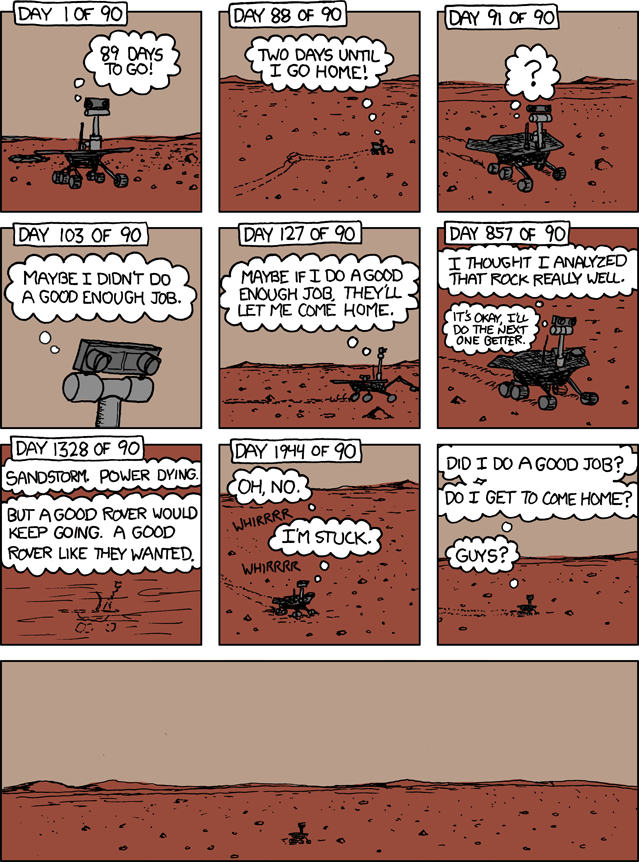
Two: The stubborn insistence on maintaining human space exploration seems like bad policy to me. For one thing it is much more expensive to send humans into space than robots. Robots don't have to breathe after all. And if the Terminator franchise has taught us anything, its that robots can do all kinds of cool things humans can't. They could have eyes that take in the full-spectrum of light for instance. So not only are robots cheaper, they are better for science too. And despite what this XKCD strip would have you believe, they don't have feelings.

Tuesday, January 26, 2010

Talking more about the corporate personhood debate

So there's plenty of stuff out there, but I guess to kind of open up the discussion with us- Basically under the new ruling, corporations (acting as persons) may donate unlimited amounts of money to political campaigns as well as run whatever ads they want previous to an election (McCain-Feingold banned issue ads 30 days before a campaign or some such). So basically I think we've all agreed that this is the end of civilization as we know it, but going over some of the fine points I think there's some points worth considering.

First of all, the old law was arbitrarily enforced in that some corporations had unlimited access to media. Specifically, corporations like say, the New York Times, which endorsed Barack Obama before the election. The New York Times is a corporation like any other, so why would it specifically be banned? Or to take it the other way, Fox News was also exempt. So in that respect, this law is acting as a leveler.

Also worth considering is the concept that corporations merely act as a mediator of personal communication. This is to say that corporations have rights the same way property does. A baseball does not have any rights, but by merit of my right against unreasonable seizure it acts as a vessel of my rights. This isn't the argument the court is making, because it explicitly applies 14th amendment protections to corporations. So by merit of the fact that corporations are ultimately groups of people, they acquire the right to unfettered communication.

Bear in mind that limiting groups has some bad implications. If we are going to reign in the talk of say, Pepsi, what is the meaningful distinction between Pepsi and the ACLU? One could argue it was a profit motive. Any of these limits are going to be arbitrary.

I'm still down for limiting corporate forays into public speech, they point is that McCain Feingold was a problematic means of doing it.

Cruel and unusual?

Dungeons & Dragons Prison Ban Upheld - NYT:
Prisons can restrict the rights of inmates to nerd out, a federal appeals court has found.

In an opinion issued on Monday, a three-judge panel of the Chicago-based Seventh Circuit Court of Appeals hexed a lawsuit challenging a ban on the game of Dungeons & Dragons by the Waupun Correctional Institution in Wisconsin.

...

Prison officials said they banned the game at the recommendation of the prison’s specialist in gangs, who said it could lead to gang behavior and fantasies about escape.

The game could “foster an inmate’s obsession with escaping from the real-life correctional environment, fostering hostility, violence and escape behavior,” prison officials said in court. That could make it more difficult to rehabilitate prisoners and could endanger public safety, they said.

Thursday, January 21, 2010

if health care wasn't doomed before...


I pledge allegiance to the flag of the United Corporatocracy.
Debatability is a voter. Just thought everyone should know.

Wednesday, January 20, 2010

Lost is coming back


Final Season Of 'Lost' Promises To Make Fans More Annoying Than Ever

Love the caption toward the end: "Government Modeling efforts on successful Containment of 'The Wire' fans."

Monday, January 18, 2010

General debate sites

http://www.infiniteprep.com/?cat=15

Debate cards with impacts on it

http://sdiencyclopedia.wikispaces.com/

Debate encyclopedia (since no one reads/owns the book)

Remembering Dr. King


Everyone knows Martin Luther King was a hero who lead a movement for voting and civil rights for African Americans. Everyone knows that he was tragically cut down before his time in Memphis, Tennessee by the bullets of a bigot.

The circumstances surrounding his death, what he was doing in Memphis, are not as well known.

Why He Was In Memphis - Peter Dreier
King went to Memphis to support African American garbage workers, who were on strike to protest unsafe conditions, abusive white supervisors, and low wages -- and to gain recognition for their union. Their picket signs relayed a simple but profound message: "I Am A Man."

If he were still alive, King would surely be working with unions, clergy, and community groups to raise the federal minimum wage, enact local living wage laws, expand health insurance to all Americans, and help America's working poor -- hotel workers, janitors, security guards, hospital employees, grocery workers, farmworkers, and others -- unionize for better working and living conditions.

Today we view King as something of a saint, his birthday a national holiday, and his name adorning schools and street signs. But in his day, the establishment considered King a dangerous troublemaker. He was harassed by the FBI and vilified in the media. He began his activism in Montgomery, Alabama, as a crusader against the nation's racial caste system, but the struggle for civil rights radicalized him into a fighter for broader economic and social justice. He recognized the limits of breaking down legal segregation. What good was winning the right to eat at a dime-store lunch counter if you couldn't afford a hamburger and a Coke?

The whole thing is worth reading.

Friday, January 15, 2010

On the importance of maintaining proper media control

Lets take a second and talk about the president of North Korea. I speak of course, of the benevolent and immortal Kim Il-Sung. Kim Jong-Il is the Supreme Leader of North Korea on account of being the Secretary General of the communist party and supreme commander of the military. This makes North Korea the first viable necrocracy. I think, anyway. That statement is couched in ignorance.

Anyway, Kim Il-Sung, due to poor nutrition as a child (growing up poor in Korea has been rough for a while) and some other complications had a growth on the back of his neck. Towards the end of his life it was roughly the size of a baseball. Due to the fact that it was so close to his spinal chord, it was basically inoperable because of the fear that he would be paralyzed.

This is one of the few photos that actually shows it, because as you might imagine Kim Il-Sung only allowed pictures to be taken from the good angles. Here's the thing though, it's not especially well known about him, so his media manipulation worked brilliantly. Theoretically this is harder now, but when you consider how much a government can clamp down on information, it's pretty amazing.

So if you ever run a third world country, pay attention to North Korea. They're a very tight operation in a lot of respects.

Letters from Satan

This is funny:

Dear Pat Robertson,

I know that you know that all press is good press, so I appreciate the shout-out. And you make God look like a big mean bully who kicks people when they are down, so I'm all over that action. But when you say that Haiti has made a pact with me, it is totally humiliating.

I may be evil incarnate, but I'm no welcher. The way you put it, making a deal with me leaves folks desperate and impoverished. Sure, in the afterlife, but when I strike bargains with people, they first get something here on earth -- glamour, beauty, talent, wealth, fame, glory, a golden fiddle. Those Haitians have nothing, and I mean nothing. And that was before the earthquake.

Haven't you seen "Crossroads"? Or "Damn Yankees"? If I had a thing going with Haiti, there'd be lots of banks, skyscrapers, SUVs, exclusive night clubs, Botox -- that kind of thing. An 80 percent poverty rate is so not my style. Nothing against it -- I'm just saying: Not how I roll.

You're doing great work, Pat, and I don't want to clip your wings -- just, come on, you're making me look bad. And not the good kind of bad. Keep blaming God. That's working. But leave me out of it, please. Or we may need to renegotiate your own contract.

Best,
Satan

Via.

We debated today!

If you weren't there, then you are not the small group of people who was present. Anyway, that's a terrible sentence. So is that. (Also really this whole paragraph, especially including the paranthetical part.)

Ok. So first debate was about Google pulling out of China, and was pretty standard stuff. Basically if you do that, don't define net benefits solely to Google which is a publicly traded corporation with a legally required profit incentive. However, something that came up is open source. Namely, I think it might be good to dwell a little bit on how Intellectual Property may well be damaging to the human condition.

Now open source generally refers to the practice of making source code for programs available so that anyone can modify them, but in terms of the human condition it brings up a vague concept called "the right to fork." It sounds kind of dirty, but basically it goes like this:

Microsoft word is in development. Along the way, an issue comes up. Should it be programmed to maximize compatibility or focus on a proprietary file format that allows for more rich text type features? Whoever owns the intellectual property, in this case Microsoft, will decide which way development takes. Either way, the end state will develop in only one way. There is an opportunity cost associated with this management choice, and due to intellectual property there will only be one version.

However, if the "right to fork" was present, no one would own the program, and both developers could take it in their own way. For an example of this concept in action, we can look at say Linux. There's Red Hat (if that's still around), Ubuntu, Lindows, whatever. Everyone is free to take it their own way, which encourages a high amount of creativity.

This isn't to say that this approach is to be lauded over all others or something, but its another take on the concept of intellectual property. It's what I thought about during the google debate when the concept of "open source" came up, because as far as I know Google's stuff is all propitiatory. Apparently Android isn't, but it's not like you'll find out how their ads work.

Onto space!

Thursday, January 14, 2010

Lets talk about repression

I feel like in debate we end up talking a fair bit about government construction, invasions, and that kind of stuff. So, in the spirit of that, lets talk about some practical lessons in applying military force.

First off, I guess we should talk a little bit about insurgencies. These things are also called "fourth generation" forces, though it doesn't really matter. Basically, we're talking about pissed off people with guns. The big problem here is that technologically we're now at a point where weapons are much more powerful than armor. A M1A1 Abrams is not all that difficult to blow up with access to the proper hardware. In this case being armor piercing RPGs. Not that it's easy, but it's doable. For the record, the M1A1 has the most advanced armor on the planet. Even body armor with SAPI plates or whatever they're using these days is only going to save you under a limited set of circumstances. Basically, any jackass with an AK-47 (and there are a lot of those) has a decent chance of killing you. Partisan/guerilla/insurgencies whatever you want to call them are thus effective at repelling invasions for the following reasons:

1) Since they're all locals, they don't have any kind of logistics worries (they all have their own source of food... or not and that's why they're shooting to begin with) and they know the local terrain.

2) Since they're all locals, killing them off tends to spur rather than dampen morale.

3) They recruit very easily, since they're local. With a few suitcases of cash (Generally provided by foreign intelligence agencies) and a willing weapons dealer you can raise an army.

So this makes these armies insanely hard to fight. At best, you get them to shut up for a bit. This is the kind of army that kicked us out of Veitnam, kicked the Soviets out of Afghanistan, ETC. The best way we've found to fight them so far involves take and hold tactics but they're very manpower intensive. You can't just strategically bomb this kind of army out of operation the way you would a conventional army.

The good news is, for the perspective repressor, that you can prevent these from forming. The best historical example is countries such as Chile, Argentina and Uruguay. The key is that you need to start killing people BEFORE they take up arms. You need to kill a whole lot of them. The purpose is a mass ideological cleansing, and then to make people so panicked that by the time you step in they're happy for any law and order. For this reason, this stuff works best if done as kind of a false flag. At the very least, you need to be vehemently dishonest about who you are fighting. Don't say "we're cleansing leftists or rightists", say "we're fighting terrorists."

I need to do some research into how to stop these groups from forming for foreign invasions, but in case of a Junta, here's how you keep things quiet.

Chart Wars


Amusing and interesting stuff.

Views on Economic Inequality


That's Paul Krugman giving a pretty nice encapsulation of the standard liberal view on economic inequality. It's an account of recent economic history I happen to agree with, and think is well-supported by the facts. My view is that large concentrations of wealth, coupled with our money-driven campaign system, undermines our democracy. Moreover, I think the extreme levels of wealth and income inequality in the United States are symptomatic of eroding levels of economic opportunity and a fraying social contract.

But hey, I'm a standard liberal so it's not all that surprising I accept the standard liberal view on economic inequality. But did you know some people disagree with me? Yes, I am shocked as well.

Views on economic inequality (some right, some sort of right, and some just wrong):

Reducing poverty, not inequality - Martin Feldstein

The Middle Is Falling Out of the Economy - Harold Meyerson

Does Inequality Still Matter? - Will Wilkinson

How much refridgerator can you buy? - Mike Konczal

Inequality: A Problem? - Bruce Bartlett

Is Our Tax System Helping Us Create Wealth? - David Kay Johnston

Wednesday, January 13, 2010

don't give ultimatums unless you can follow through

What we can learn from the defeat of the Ottomans at the Battle of Vienna to ensure our victory in these upcoming tournaments.

1 - never leave your big cannons behind
Mustafa made a critical error when traveling to Crimea to overtake the city. Due to unforeseen rains, he could not drag these heavy cannons to attack. After setting an ultimatum of surrender or face total annihilation, his army was too weak to take down the walls; and his troops suffered greatly.

Looking at this from a debate perspective, we can see that it's a bad idea to leave behind critical information. You must build up your artillery of logical fallacies, topical current information, and Ks that will certainly knock the walls of the opponents down, leaving the floor wide open for your military men (disadvantages) to lead to total destruction. (win!)

2 - don't let your logic get cholera
After realizing his army needed new tactics, Mustafa set to starve the city to death. Yet, while he waited for the opposition to die on it's own - His own army suffered greatly. The camps deteriorated over time, and diseases spread wide throughout his mighty army. Poor sanitation and long, unproductive weeks led to unnecessary degredation of troops.

Debate-wise, we know that letting your mind sit around for too long is bad for the brain, and definitely bad for the army of knowledge in your mind. Facts will get bored, or worse diseased, and run out of your ears. Or become so sick that you mix up information. Keep that logic well maintained, and clean. Update your mental data-base often.

3 - don't let your opponent through the narrow passes in the alps
This was a critical mistake in Mustafa's planning for troops. He underestimated the power of the army coming to save the city, and left the only two extremely narrow passes in the alps to get to Crimea wide open for troops to come through. Sobieski and his men waltzed through those mountain passes unharmed, and surrounded Mustafa's army. Trapping them, and leading to their inevitable defeat.

Don't let those technicality get away. Maybe you think you can drop an inane point, but it will be this that comes back to corner you against the opposition's argument that you were sure you were going to defeat. But now, you are left surrounded with no strong points. If only you had closed up those gaps in the Swiss Alps of your plan. Definitely make sure your argument is rock solid, before finishing the job of destroying their already weak counter-plan.


We can also learn from Sobieski here, to know that the underdogs have a historical precedent of winning. So even when all hope is lost, join forces with Austria, and kick some Ottoman ass.

Some weird data about what we think

I'll preface this with saying I'm kind of [CRC] at the moment. Looking over this document, I can't help but notice some awesome stuff. To whit, in 1962 78 percent of Americans reported never having a religious experience, while in 2009 49 precent reported never having a religious experience. The flip sign of this has grown as well. In 1962 22 percent of Americans believed they had had a religious experience, now in 2009 48 percent of them do.


Shouldn't the iron cage be taking care of this crap? Argh! To be fair, there are any number of explanations for this, it's just depressing that the number of people who have been around ghosts has increased in the past decade. Guess the ghosts are getting better marketing these days.


Ill trees bear ill fruit.

Slippery slope arguments!

If we start providing healthcare for poor people, then we'll have to provide healthcare for poor, sick people, then poor, terminally ill people and then poor, dead people. Since dead people aren't allowed to own property, all of them are poor. Trying to revive them from the dead will bankrupt us!

If we build a fighter jet, then we'll have to sell them to offset the cost of building it, but then we'll have to develop a new fighter jet in case we start a war with the people we just sold them to. (Whoops that one came true)

If we ban abortion, soon we'll have to ban all babies exiting the uterus and no babies will be born! Women will stop becoming pregnant since it will be a death sentence and human civilization will end.

If we don't accept this spec argument because we don't know what it means, then we would have to disregard all argumentation where we don't know what it means. Soon all of the stupid kritiks (boundaries, empire, neo-marxist feminism) would have to be dropped because they make no sense! Then debate would die because people would start communicating and stop competing.

Hmmm... last one was the weakest. Help me out here.

Avatar revisited

So talking with the esteemed Professor Longshanks McGee, he thought I should post a bit more about Avatar but from a moralistic point of view. He feels that I'm making too many assumptions about smurf-cat-people biology. Whatever.

So you know the plot of Avatar, but it doesn't have the moral you might think. It is true that it ends with generic protoganist joining the natives and living in harmony with nature without any pesky things like medicine to hinder him. However, it's also important to remember that in the climactic battle of corporate greed versus living in tune with nature, the natives lose. They actually get annihilated wholesale, though this isn't particularly addressed by the ending. They only triumph due to the divine intervention of their God, which carries a valuable message for people who are looking at exploitation the world over. If you don't literally have divine intervention on your side, you are screwed.

So roll over and accept Chicago School free market economics already. I'm looking at you, Venezuela!

I have mine with chocolate milk

The Pop-Tart wikipedia page is really fascinating.

This could be an interesting cultural artifact for someone. If it hasn't been done already.

Those Haitians brought it upon themselves...

http://www.cbsnews.com/blogs/2010/01/13/crimesider/entry6092717.shtml

Imagine if this psycho had been voted in when he was running for election...

Awesome parts to the unemployment rate

So there's been some concern about these high rates of unemployment, especially in the service sector, but I'd like to touch on the brighter side. Basically, if we look at labor as a supply/demand situation, the higher demand is, the more things are skewed towards labor. The more supply, the more things are skewed towards management. So, a sustained, high unemployment rate should skew things towards management. This could be considered good for a number of reasons.

1) If you already have money, you'll enjoy price drops. Management will have to spend less money on labor, as they'll be able to drop wages and benefits but still get people because they're desperate.

2) If you're in a position where you hire lots of unskilled labor, you can probably abuse them more than normal because they'll be willing to tolerate abuse and you can easily replace them if they don't.

3) Maybe labor conditions will drop low enough that we can compete with China.

I know it's kind of a dark view, but so much of our policy in this country is formulated on how it will benefit the rich. Now, I wonder what all those rich people I follow in the news are up to. If only I could lead that blessed life!

Links - 1/13/09

Health-care:

Your Handy Health Care Cheat Sheet - Wash Post
If you're having trouble understanding what HCR is all about, this is a very good summary. It's from August but still current.

Health-care reform: How the bills stack up - Wash Post
Nifty interactive graphic that give a quick rundown of the content of the Senate and House Bills.

The importance of the individual mandate - Ezra Klein, Wash Post
The individual mandate is one of the most controversial and confusion-inducing aspects of reform. I'd tell you more, but that would kind of defeat the whole purpose of linking.

Jobs:

What Types of Employment Policies Should be Discussed at the Jobs Forum? - Mark Thoma, CBS Moneywatch
Things the government can do to potentially boost employment.

American Jobs Plan - Economic Policy Institute
Good policy ideas from the progressive think-tank.

Financial Regulation:

Americans for Financial Reform
This has been a helpful site for me in my feeble attempts to understand financial reform.

What Caused the Economic Crisis? The 15 best explanations for the Great Recession. - Jacob Weisberg, Slate

Estate Tax

Policy Basics: The Estate Tax - Center on Budget and Policy Priorities
Nice intro to the estate tax. Check out their "Myths and Realities" paper too.

Rich Cling to Life to Beat Tax Man - Wall Street Journal

When the Levy Breaks - Tim Fernholz, Newsweek

Tuesday, January 12, 2010

Why Forensics ruins aesthetic appreciation

So I'd like to talk about Avatar, John Camerons latest testament to (a) Sigourney Weavers MiLF status and (b) awesome CGI. So, for those of you who haven't seen it, let me one sentence the plot for you: A group of generic natives who are in tune with nature try to resist exploitation by greedy corporations. It's like Pocahontas, except the Americans win.

Anyway, when watching this movie I was immediately gripped by some fundamental problems with the Navi. Or whatever the 12 foot tall cat people are called. When they gather their fetish fuel army, which consists of 2000 cat people and their mounts, which are either giant pterodactyls or giant horse-dinosaur things, they camp out in the mountains and mass for an assault. However, they're also a hunter gatherer society. This is where my enjoyment of the movie is stepped on by being a "critical thinker".

Hunter gatherer societies actually have a lot of neat properties. They're the most egalitarian, and generally the most democratic organizations. This is seen in the movie when the suitably square jawed protagonist, whose name is like Josh or Jack or something, gets to speak at the pow-wow despite being nobody. Also notable is that there are very few specialists in a hunter gatherer society, because there is only enough economic excess to support a couple. Generally you get a shaman and a big man or chief. There's some wonderful distinctions to be made here, but you get the idea.

Part of the reason it is so egalitarian is that everyone needs to work to generate the amount of goods required for sustenance. Everyone needs to hunt or gather if everyone is going to eat. There's no time to have say, a dedicated doctor, because if you did who would feed him? Coincidentally, it's sort of assumed in the movie that the Naavi are awesome warriors because they're good hunters, and this is sort of assumed in a lot of depictions of these sorts of society. However, it's a skillset that doesn't entirely transfer. I don't think it really matters in the movie. So here's the other problem, in order to get enough calories to sustain someone, you need a fairly large area of land doing the whole hunter gatherer thing. This is why there are never concentrated populations of hunter gatherers. They'd starve.

So, when they're amassing in the mountains, what are they eating? How are they able to raise this big of an army? There's a reason there are only hunter gatherer societies in areas nobody wants. The farmers always win, because there's always more of them.

The other thing is that we're talking about 12 foot tall cat things. It's gotta take a lot of calories to keep that going. So, I guess what I'm saying is, in order to generate an army that big, they would need a lot of food they don't have.

Fortunately they all get slaughtered at the end, so that at least alleviates that concern. Sadly, as the cat things were getting killed I was thinking "At least they won't have to do as much hunting tonight."

Yay Forensics!